
Responsibility · Environment
An active grown by fermentation.
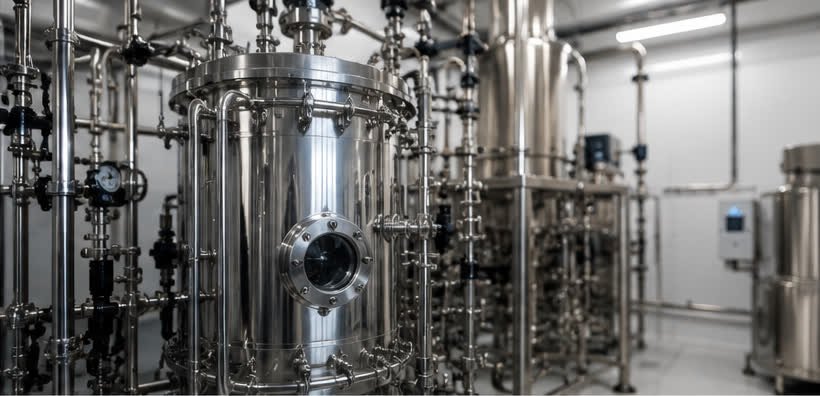
Growing the active in a fermenter sets the land use, the inputs, the energy load, the waste stream and the packaging. Each of those is stated below, with what we commit to as volumes grow.
- Production
- Fermentation
- Land use
- None
- Animal inputs
- None
- Biomass
- By-product streams
In practice
Land use, inputs, energy, waste, packaging.
Most of these follow from the production route itself and hold at any volume.
- Grown in liquid culture
- The active grows in a fermenter. No land-use change, no wild harvest, no monoculture footprint behind the supply chain.
- Defined inputs
- The yeast grows on a defined medium of sugars, salts and nitrogen sources. No animal-derived components, no rare botanical inputs to compete for.
- Energy and water
- Bench and pilot operations run on grid renewables where available, and process water is recycled in clean-in-place loops.
- End of life
- Spent yeast biomass is biodegradable and routed into agricultural by-product streams rather than to landfill.
- Packaging
- Recyclable glass primary packaging and FSC-certified secondary packaging on finished goods from launch.
- Output scales with tank volume
- Volume grows with fermenter capacity. Acreage, crop yield and harvest season are not part of the supply equation, so the footprint does not track demand.
Next step
Sustainability questions from procurement?
We answer them in writing, including the ones we do not have a finished number for yet.