
We grow, isolate, load, and test yeast exosomes.
Our platform starts with Saccharomyces boulardii, a probiotic yeast. During growth, the yeast releases extracellular vesicles into the surrounding media. We isolate those vesicles, purify them, load them with selected skincare actives, and test their biological effects.
- Organism
- Saccharomyces boulardii
- Grown in
- Bioreactors
- Loaded with
- Skincare actives
- Tested in
- Skin cells and models
From bioreactor to characterized ingredient.
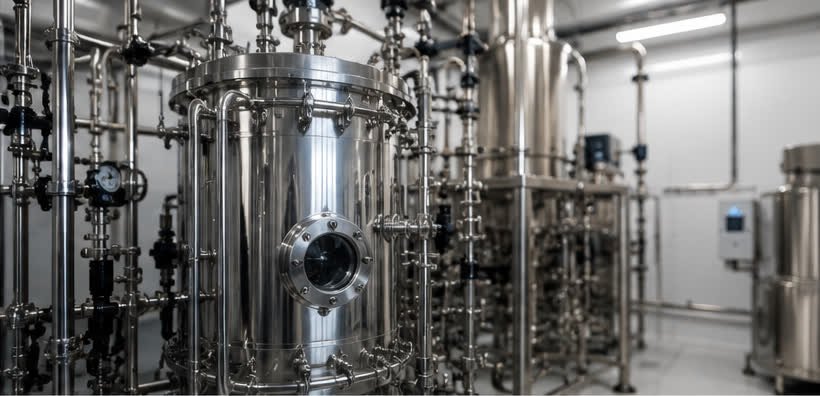
We grow the yeast.
We grow S. boulardii under controlled conditions in bioreactors. Fermentation allows us to control growth conditions while producing exosomes at increasing scale.
We isolate the exosomes.
The yeast releases extracellular vesicles during growth. We separate them from the fermentation media and purify them before further use.
We load skincare actives.
We load selected cosmetic ingredients into the purified exosomes. This combines the properties of the yeast exosome with those of the loaded active.
We characterize them.
We measure properties such as particle size, particle concentration, purity, active loading and stability. This allows us to understand both the exosome and the final loaded ingredient.
We test them.
We test our exosomes and loaded formulations in skin cells and models relevant to anti-aging skincare.
Our work focuses on areas relevant to anti-aging skincare.
- Oxidative stress
- Skin cell health
- Inflammatory responses
- Skin barrier function
- Firmness and elasticity
- Visible signs of aging
The exosome is not just a container.
It carries biological material made by the yeast itself. That means the vesicle contributes its own activity while also carrying the skincare ingredient loaded inside it.
The carrier is part of the active.
S. boulardii gives us a production system that is fundamentally different from mammalian-cell exosomes.
- It grows quickly.
- It is compatible with fermentation.
- It can be scaled in bioreactors.
- And it gives us a non-mammalian source of extracellular vesicles for skincare development.
Request technical information.
Characterisation, handling and the testing behind any of the five steps above. Ask the specific question and a founder answers it.